



2026 Bookish Books Reading Challenge (hosted by Yours Truly)

2026 Cover Lovers Reading Challenge (hosted by Yours Truly)


2026 Historical Fiction Reading Challenge

2026 POPSUGAR Reading Challenge

Booklist Queen's 2026 Reading Challenge

2026 52 Club Reading Challenge

2026 Craving for Cozies Reading Challenge

2026 Medical Examiner Mystery Reading Challenge

2026 Mount TBR Reading Challenge

2026 Around the Year in 52 Books Reading Challenge

Shelf Reflection Candy Reading Challenge for Kids (and Adults)

2026 Countdown Reading Challenge

Dragon Rambles' Law of Fives Bingo

2026 Southern Literary Reading Challenge

2026 Reading Challenge (by Linz the Bookworm)

2026 Pioneer Book Reading Challenge

European Reading Challenge 2026

2017 Pick Your Poison Reading Challenge (retired challenge - doing old boards for fun)

2026 Reading Challenge Addict Reading Challenge

The 100 Most Common Last Names in the U.S. Reading Challenge

The Life Skills Reading Challenge

Mormon Mentions: Dusti Bowling
If you haven't got a clue what a Mormon Mention is, allow me to explain: When I see a reference to The Church of Jesus Christ of Latter-Day Saints (known more commonly as the Mormons) in a book which was not written by a member of the church, I post it here. With commentary from Yours Truly. I'm no theologian, but I try to explain doctrinal issues as well as debunk myths and clear up misconceptions. Speaking of, I should probably make this crystal clear: I do not have horns. I do not belong to a cult. My dad only has one wife. As does my husband. And, yes, people really have asked me all of those questions. Just FYI: mainstream Mormons haven't practiced polygamy for more than 120 years.
Everybody got that? Great. Let's move on ...

Mormon Mentions: Daniel James Brown
Just to be clear, my father only has one wife. As does my husband. No, I do not have horns hidden underneath my hair, nor am I a member of a cult. Believe it or not, I have been asked all of these questions before!
----
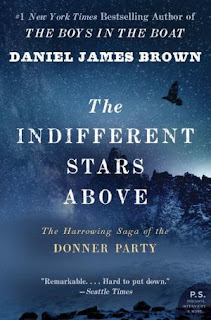
In The Indifferent Stars Above, Daniel James Brown mentions Mormons—who, under the direction of Brigham Young, established a colony in Utah's Salt Lake Valley in July 1847, a year after the Donner Party took their ill-fated journey—four times. I chose just two of the passages to talk about here.
"For the next two weeks, they [the Donner Party] rolled northwest, passing and being passed by elements of what had been the Russell Party, now under the leadership of Lilburn Boggs, the fiercely anti-Mormon former governor of Missouri who had taken over leadership when Russell resigned on June 18" (77).
Lilburn Boggs is a well-known villain in Mormon history. I grew up hearing tales of his hateful persecution of early members of The Church of Jesus Christ of Latter-day Saints. From 1836 to 1840, he served as governor of Missouri, where he dealt with heated conflict between members of the Church and residents of Missouri, who were concerned about the influx of Mormon settlers to the area. Many Missourians were outraged by their presence and sought to drive the religious group out of Missouri. Boggs agreed, issuing Missouri Executive Order 44 (known as the "Extermination Order") on October 27, 1838. In part, the order said: The Mormons must be treated as enemies, and must be exterminated or driven from the state if necessary for the public peace—their outrages are beyond all description. If you can increase your force, you are authorized to do so to any extent you may consider necessary. Fearing for their lives, thousands of Church members fled the state in terror. This kind of persecution followed them wherever they went, prompting their eventual migration to Utah.
I've never thought about what happened to Boggs after that, so I was startled to see his name in The Indifferent Stars Above. Some say he headed to California because of his fear of Mormon retaliation (someone did try to kill him in 1842, although the identity of his would-be assassin was never discovered). Whatever his reason, he journeyed to the Sunshine State in 1846 with a party of pioneers that included his wife and children. They settled in Sonoma, where Boggs became a store owner and a postmaster. He died in Napa County in 1880. So says that venerable news source Wikipedia, anyway.
"There is anecdotal evidence...that the winter of 1846 was unusually cold across the Northern Hemisphere...At their Winter Quarters in Nebraska, thousands of Mormons suffered terribly, and more than six hundred of them died, in bitterly cold blizzards that swept across the plains" (226).
I also grew up hearing stories about the great suffering of the Saints in Winter Quarters, although none of my Mormon pioneer ancestors were among them. It's a sad chapter in our history. There is now a Mormon Trail Center on the Winter Quarters site in Omaha, Nebraska, where you can learn more about what happened there.
Mormon Mentions: Jon Billman

If you haven't got a clue what a Mormon is, let alone a Mormon Mention, allow me to explain: When I see a reference to The Church of Jesus Christ of Latter-day Saints (nickname: Mormons) in a book which was not written by a member of the Church, I post it here. With commentary from Yours Truly. I'm no theologian, but I try to explain doctrinal issues as well as debunk myths and clear up misconceptions. Speaking of, I should probably make this crystal clear: My dad only has one wife. As does my husband. And, yes, people really have asked me those questions. (I've also been asked if I have horns. Of course I do! I just keep them hidden under my hair. Duh.) Just FYI: mainstream Mormons haven't practiced polygamy for more than 120 years.
Everybody got that? Great. Let's move on...
In The Cold Vanish, Jon Billman talks about the search for a man named Troy James Knapp, a survivalist who lived off the spoils he acquired from breaking into cabins in Southern Utah for seven years before he was caught and jailed in 2013.
- Of Southern Utah's arid landscape, Billman says: "It was drier than a Mormon wedding." (205)
- About Knapp: "At times he appeared angry at Latter[sic]D[sic]ay Saints—he shot holes in a portrait of Joseph Smith and ripped up the Book of Mormon." (200)
Mormon Mentions: Libby Copeland

Mormon Mentions: Sonja Yoerg

(Note: In 2018, Russell M. Nelson—president of The Church of Jesus Christ of Latter-day Saints—made an impassioned plea to members of the Church and to the media to always use the full and correct name of the Church instead of referring to it by its various nicknames. This led to the renaming of many Church entities, including its famous choir, which is now The Tabernacle Choir at Temple Square. Although I have been trying to think up a clever new name for this feature that is more in line with President Nelson's request, for the moment it remains "Mormon Mentions.")
Mormon Mentions: Katie Tallo

(Note: In 2018, Russell M. Nelson—president of The Church of Jesus Christ of Latter-day Saints—made an impassioned plea to members of the Church and to the media to always use the full and correct name of the Church instead of referring to it by its various nicknames. This led to the renaming of many Church entities, including its famous choir, which is now The Tabernacle Choir at Temple Square. Although I have been trying to think up a clever new name for this feature that is more in line with President Nelson's request, for the moment it remains "Mormon Mentions.")
---
Whenever I read a book that is set in a real place, I'm always curious to know which details about it are true and which are made-up to suit the story. Elgin—a town in Ottawa, Canada—plays a big role in Dark August by Katie Tallo. The way she describes it, especially as an abandoned village decimated by a toxic waste explosion, makes it sound like a fascinating place. Unfortunately, she did not include an author's note explaining what in the book is factual and what is not, so I had to do some digging on my own. Here's what I found:
While Elgin is, indeed, a real place, the whole toxic waste explosion/ghost town thing is 100% fiction. If you Google the town, you will see that it's a teensy (population: about 300) village southwest of Ottawa that appears to be a quaint, lovely place to live.
Mormon Mentions: Jon Erwin and William Doyle

(Note: In 2018, Russell M. Nelson—president of The Church of Jesus Christ of Latter-day Saints—made an impassioned plea to members of the Church and to the media to always use the full and correct name of the Church instead of referring to it by its various nicknames. This led to the renaming of many Church entities, including its famous choir, which is now The Tabernacle Choir at Temple Square. Thus, I'm trying to think of a new name for my "Mormon Mentions" feature. Any ideas?)
--
In Beyond Valor, the authors discuss how various Medal of Honor recipients react to the award, which often honors actions taken on the worst day of their lives. On Page 96, it says:
"Some recipients have battled depression, post-traumatic stress disorder (PTSD), and periods of great despair and failure in civilian life. Pvt. Thomas C. Neibaur of Idaho was the first Mormon to receive the Medal of Honor, which recognized his actions in France on October 16, 1918. In 1939, discouraged by misfortune and unable to feed his family, Neibaur mailed his Medal of Honor and other decorations to Congress, stating, "I cannot eat them." Within three years, both he and his wife died, and their four sons were sent to an orphanage in Michigan."
I'm not sure what to say about this except what a terribly sad story. I did find this article about Neibaur, which gives more details about his life and military service.
Cousin Jacobs' Newest a Fun, Upbeat Look at One of My Favorite Hobbies

 A couple years ago, my husband and I attended RootsTech, a big annual genealogy conference held in Salt Lake City. One of the featured speakers that year was A.J. Jacobs, a self-proclaimed "human guinea pig" who enjoys coming up with crazy projects, then writing books about them. That year, he spoke about his interest in family history. He had just finished a year-long quest to learn how to research his roots and hold the biggest reunion on record with his newfound relatives (which basically includes everyone in the world, since he discovered we're all cousins in some way or another). At that time, he was writing about his experience in the book that would become It's All Relative. Jacobs' presentation was so engaging that I knew I wanted to read all about the project. Not surprisingly, the book, which came out earlier this year, is funny, upbeat, and enjoyable. If you're looking for a step-by-step how-to manual on how to research your family history, this is not it (for that, I recommend checking out familysearch.org or hitting up your local LDS research center for free help). It's All Relative is much more about entertainment than instruction.

Mormon Mentions: Carol Goodman

--
Nan Lewis, the main character in River Road by Carol Goodman, teaches creative writing at a college in upstate New York. At the end of the novel, she's describing pieces written by her students. She says:
- I would totally read a memoir (probably even an irreverent one) about growing up Mormon in Scotland!
- The LDS Church was introduced in Scotland in the mid-1830s. Over the next 2o years, almost 10,000 people joined the church. More than 7,000 emigrated to the United States to join with Mormon pioneers from the U.S. and other countries on the trek to Zion.
- Although I couldn't find any current statistics for church membership in Scotland alone, there are 186, 423 members in the U.K. (according to MormonNewsroom.org).
Mormon Mentions: Rae Carson (Part II)

--
In the first chapter of Like a River Glorious by Rae Carson, Lee and Jefferson talk about going to Mormon Island for supplies. The name, which I'd never heard before, naturally made me curious. I did a little Internet research and this is what I discovered:

 In March of 1848, three former members of the Mormon Battalion stopped at the confluence of the north and south forks of the American River near Sacramento, California. There, they found gold. Their discovery brought other settlers to the area. A town grew up on the site; by 1853, more than 2500 people lived on Mormon Island. It had a school, motels, saloons, a winery, a post office, and other small shops. That population dwindled as the Gold Rush waned. When a fire burned down much of the town, it was never rebuilt. By the 1940s, only a few families remained. In the 1950s, the remains of the town were razed to make way for the Folsom Dam. What's left of Mormon Island is now under Folsom Lake. When the water there is very low, however, building foundations and other artifacts from the outskirts of the early settlement can be seen.
 *Book cover image from Barnes & Noble; Mormon Lake photos from website for the Folsom Lake Marina
Mormon Mentions: Rae Carson

**
Most Western or Western-ish novels mention Mormon pioneers, as they played an indelible part in the settlement of the western United States. So, it's no big surprise that these iconic travelers make an appearance in Walk on Earth a Stranger by Rae Carson.
Warning: The following may be a little spoiler-y. Proceed with caution!
 Toward the end of the novel, Leah and company approach Independence Rock, a large, granite monolith in Wyoming. Many real travelers carved their names in the rock. Some of these inscriptions can still be seen today. While discussing the rock, Jefferson says:
"The Mormons came this way. And folks going to Oregon. People have been passing by this rock for a long time." (quote at Location 4077 in e-ARC).
Independence Rock was often mentioned in journals kept by Mormon pioneers. My own ancestors passed by it. Although I've never visited the site, I'd love to someday.
*Book cover from Barnes & Noble; Independence Rock image from Wikipedia
Mormon Mention: Laura McNeal

--
In The Incident on the Bridge by Laura McNeal, police officer Elaine Lord says this about her partner:
"Skelly was just like her nephews. Money was for buying nice cars, plain and simple. She hadn't wanted to work with him at first because of his various childlike views and because he was a twenty-five-year-old Mormon the size of Sasquatch. It had turned out, though, that he gave her a little of the old hope and ardor. Not a lot of hope and ardor, but a little" (38).
-- Not only did I not expect a Mormon Mention to crop up in a YA mystery novel set in California, but I was surprised by its positive nature. After a little sleuthing (including an email to the kind and patient Laura McNeal), I discovered that the author grew up LDS. Although she now considers herself a secular humanist, she respects her Mormon family and friends and "the grace and strength their faith gives them." This respect is definitely reflected in her portrayal of Skelly.
Mormon Mentions: Lisa Beazley

--
In Keep Me Posted by Lisa Beazley, 34-year-old Cassie Sunday is composing a letter to her sister. An exhausted stay-at-home mom, she writes:
"I just remembered something. When the boys were about four months old and I had been back at work for a month, I used to watch TV during their two a.m. feed. I got into that show on Showtime with Chloë Sevigny about the Mormon polygamists, and I remember thinking, these people are genius! A few extra wives really come in handy with a house full of kids. It's just good sense. We could have used an extra wife right about then (still could, actually). I would have gladly let her sleep with Leo. God knows I wasn't. I fantasized about it for weeks—not the sex part, but the wife part, the extra set of hands to take care of the babies, cook, clean, all that" (36).
-- All I can say is ha ha. And members of The Church of Jesus Christ of Latter-Day Saints haven't practiced polygamy in more than 125 years. The practice is continued by some fundamentalist sects, but these groups are not associated with the mainstream LDS Church. If you want to read more about plural marriage and the history of the Church, click here.
Mormon Mentions: Fiona Barton

Mormon Mentions: Rinker Buck
Addressing everything Buck writes about Mormons would take forever, so I just want to point out a couple passages. His account of visiting Martin's Cove, a historical site owned by the LDS Church, is hilarious. He makes some interesting points while telling a hysterical tale about his foul-mouthed brother trying to "put on his Mormon" for the visit. Buck has his criticisms about how the Church acquired and runs the site, but the brothers' experience there made me laugh 'til I cried."Reaching the Oregon Trail in Wyoming and not confronting the Mormon experience would be like reaching Paris and not studying the cathedrals. You cannot understand one without the other" (262).

 While Buck's comments about Martin's Cove were not entirely positive, his experience on Rocky Ridge—the highest point of the Mormon Trail and one made sacred because of the extreme hardship endured there by pioneers, especially during the 1856 crossing of the beleaguered Willie Handcart Company—made a believer out of him. The fortuitous appearance of two "Mormon angels" just when the Buck brothers needed them in order to cross treacherous Rocky Ridge seemed to convince them that indeed, they trod on holy ground. Of the experience, Buck wrote, "... I loved ... everything Mormon, that day on Rocky Ridge. Indeed, standing with them on the high rocks, I was a Mormon. Today, on windy Rocky Ridge beneath a hard blue Wyoming sky, I was Mormon" (309). It's a very touching account, the most memorable part of The Oregon Trail for me.
I haven't ever visited Martin's Cove or Rocky Ridge, but I still have a great respect and love for the pioneers whose blood and tears flowed freely over both. These men and women—some my own kin—endured incredible hardships in the name of religious freedom. In obeying the God they believed in with their whole hearts and souls, they blazed trails for all of us to follow. Vital to the settling of not just Utah, but also much of the American west, the magnificence of their courage and sacrifice really can't be understated.
(Book image from Barnes & Noble; handcart painting by Brent Flory)
Mormon Mention: Kali Wallace

--
 In Shallow Graves, a debut novel by Kali Wallace, the main character—recently deceased Breezy Lim—is talking to a friend. The topic under discussion is Mr. Willow, the leader of a cult who claims he can "fix" undead people like Breezy. This exchange between Rain and Breezy occurs at the 30% mark in the e-ARC of Shallow Graves:
 "Is he as scary as they say? I'm picturing the mutant offspring of Charles Manson and Ted Bundy."
"He looks like a middle-aged Mormon missionary," I said, and Rain laughed. "I didn't realize he was famous."
- You'd be surprised at how many times book/movie characters are described as looking like Mormon missionaries. Why? Because that's probably the easiest, most visual way of conjuring an image of someone who has a clean-cut appearance. The connotation of the phrase goes beyond that, though, indicating that the person is also honest, honorable, even innocent. All of which Mormon missionaries should be. Not only do they abide by strict dress and grooming standards (read more here), but they also adhere to an exacting code of personal worthiness. If elders and sisters are doing their best to live by these standards, then they are, in fact, clean, virtuous, and worthy of serving as the Lord's ambassadors.
(Book image from Barnes & Noble; missionary image from nearingkolob.com)
Mormon Mentions: Louise Penny

--
A word of warning: This Mormon Mention may be a bit spoiler-y, so beware.
In The Cruelest Month, the third installment of Louise Penny's popular Armand Gamache series, the great chief inspector is trying to solve the case of a woman who died seemingly of fright. While discussing lab reports, he says:
"'Ma Huang. An old Chinese herb. Also known as Mormon's tea. And ephedra" (282).
- I'd never heard of Mormon's Tea (also called Brigham's Tea in reference to Brigham Young) and apparently, there's a lot of conflicting information about it. As far as I can glean from some quick Internet research, Mormon's Tea is made from a shrub common in the American Southwest that is related to the Chinese herb to which Gamache refers. Its stems are chopped up, then boiled and steeped into a concoction which is said to help with common ailments like colds, coughs, joint pain, constipation, etc. It's also supposed to cure sexually-transmitted diseases. The brew can also be drunk as an alternative to regular tea. According to this article (from which I got most of my information), however, no mention of Mormon's Tea can be found in pioneer diaries until after the death of Brigham Young in 1877. So, who knows?
If you know anything about Mormons, you probably know that we live by a health code called The Word of Wisdom, which was revealed to Church members in 1833. The edict cautions against the use of "strong drink" as well as "hot drinks." Early Church leaders interpreted the latter to mean coffee and tea. Modern leaders continue to urge us to avoid any substance that is addictive in nature, thus active LDS people generally abstain from drinking coffee and caffeinated tea. We're also told to avoid alcohol, tobacco, illegal drugs, and anything else that can be harmful to the body. Anyone whose life has been touched by addiction should be able to see the wisdom in such advice, no?
Because of the damage addiction can have on individuals, families, and society in general, The Church of Jesus Christ of Latter-day Saints offers a fantastic, free recovery program that has helped many, many people overcome addictions to not only alcohol, drugs, and tobacco, but also pornography, gambling, infidelity, overeating, etc.


Readin'

Beach Thriller by Jamie Day

Listenin'

Hidden Rooms by Kate Michaelson



Followin' with Feedly


-
-
-
-
Sweet Spot by Kemper Donovan4 hours ago
-


Grab my Button!


Blog Design by:



2026 Goodreads Reading Challenge

2024 - Elementary/Middle Grade Nonfiction

2023 - Middle Grade Fiction

2022 - Middle Grade Fiction

2021 - Middle Grade Fiction

2020 - Middle Grade Fiction
