



2026 Bookish Books Reading Challenge (hosted by Yours Truly)

2026 Cover Lovers Reading Challenge (hosted by Yours Truly)


2026 Historical Fiction Reading Challenge

2026 POPSUGAR Reading Challenge

Booklist Queen's 2026 Reading Challenge

2026 52 Club Reading Challenge

2026 Craving for Cozies Reading Challenge

2026 Medical Examiner Mystery Reading Challenge

2026 Mount TBR Reading Challenge

2026 Around the Year in 52 Books Reading Challenge

Shelf Reflection Candy Reading Challenge for Kids (and Adults)

2026 Countdown Reading Challenge

Dragon Rambles' Law of Fives Bingo

2026 Southern Literary Reading Challenge

2026 Reading Challenge (by Linz the Bookworm)

2026 Pioneer Book Reading Challenge

European Reading Challenge 2026

2017 Pick Your Poison Reading Challenge (retired challenge - doing old boards for fun)

2026 Reading Challenge Addict Reading Challenge

The 100 Most Common Last Names in the U.S. Reading Challenge

The Life Skills Reading Challenge

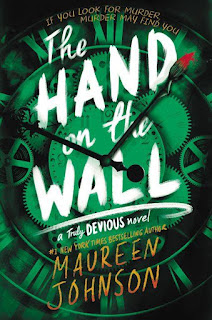
Series Review: Truly Devious by Maureen Johnson
I haven't done a series review in some time, which might have something to do with the fact that I haven't binge-read a series in some time! That changed in the last two months when I sped through the Truly Devious books by Maureen Johnson. I enjoyed all the novels, which together create a series that is clever, fun, and engrossing.
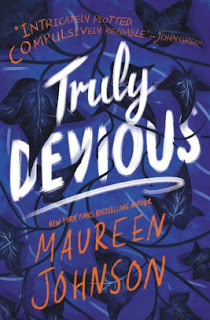
As Stevie studies the case on-site, strange things start happening on campus, things that mirror what occurred back in the 30s. When a student is murdered, it sends shockwaves through the place anew. Has the "Truly Devious" killer struck again? Or is someone playing a macabre game of copycat? Stevie vows to solve all the murders, past and present. Can she do it?
Spoiler alert: Yes, she can.
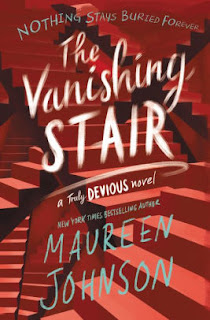
Stevie resumes her investigation into the murders that occurred at Ellingham in the 1930s. While doing so, she discovers the dead body of another classmate. Why were they killed? When another strange death happens in nearby Burlington, Stevie's certain they're connected—not just to each other but also to the Ellingham cold case. Can she get to the bottom of things before she loses someone else she cares about?
In the last book of the main trilogy—The Hand on the Wall—a series of disturbing events, plus the threat of an oncoming blizzard lead to the closure of Ellingham Academy. Despite the danger, Stevie and her friends do not want to leave. It's crazy to stay with a dangerous storm on the way not to mention a murderer running loose, but Stevie's convinced she can solve the Ellingham murders and figure out how everything that's happening in the present connects with them if only she can get a little more time. Hiding out so they don't have to leave, Stevie & Co. remain at Ellingham. As tension rises, putting them all at risk, Stevie pushes herself to puzzle out all the answers. Can she do it before they all run out of time?
After Stevie solves the Ellingham case, which has stumped investigators for decades, she becomes a bit of a sensation. In The Box in the Woods, she's home in Pittsburgh for the summer, prepared to die of boredom sans friends and without a puzzling case to keep her busy brain occupied. When she receives a tantalizing invitation to work at Camp Wonder Falls, she's immediately interested. It's not because she loves the outdoors (she doesn't), but because the rebranded summer camp was the site of a notorious quadruple murder back in the 1970s. The camp's new owner, an offbeat podcaster, wants Stevie to investigate the cold case so he can feature it on a show he's producing. Stevie's game.
Summoning her besties from Ellingham, Stevie and the reunited gang began their investigation. As they talk to residents of the nearby town who knew the victims, Stevie becomes more and more confused. Why would someone brutally kill four teenaged camp counselors? The kids weren't saints, but they hardly seem like the kind of people who would inspire the amount of rage that was unleashed on them.
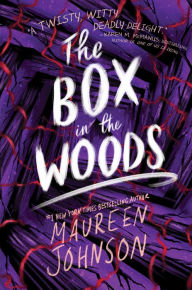
When one of the people helping Stevie dies in a suspicious accident, it becomes quickly apparent that someone knows what really happened the night the kids were killed and that they will do the unthinkable to make sure the truth never comes to light. If Stevie doesn't stop nosing into the past, she might be next. Can she solve the case before she becomes the next camp counselor to die?
It's natural while reading a series to like some installments more than others. That's true of the Truly Devious books for me, but overall, it's a very well-crafted series. The characters are fresh and likable (my favorite is Nate, by the by), the mysteries are twisty and compelling, the boarding school setting is intriguing and appealing, and Johnson's prose is skilled and upbeat. I found all of the books engrossing, which explains why I buzzed through them so quickly. In every instance, I definitely wanted to know what was going to happen next. Johnson did not disappoint.
I believe The Box in the Woods is the last book in the Truly Devious series. While it offers a satisfying conclusion to the series, it definitely leaves room for more installments. I am 100% up for that, although I'm still waiting for Johnson to finish the Shades of London series...
Grade:

Although the installments vary in content, if they were movies, all would be rated:

Despite Excited Buzz, The Library Book Is A Little Disappointing

Weaving her lifelong love of books and reading into an investigation of the fire, award-winning New Yorker reporter and New York Times bestselling author Susan Orlean delivers a mesmerizing and uniquely compelling book that manages to tell the broader story of libraries and librarians in a way that has never been done before.
In The Library Book, Orlean chronicles the LAPL fire and its aftermath to showcase the larger, crucial role that libraries play in our lives; delves into the evolution of libraries across the country and around the world, from their humble beginnings as a metropolitan charitable initiative to their current status as a cornerstone of national identity; brings each department of the library to vivid life through on-the-ground reporting; studies arson and attempts to burn a copy of a book herself; reflects on her own experiences in libraries; and reexamines the case of Harry Peak, the blond-haired actor long suspected of setting fire to the LAPL more than thirty years ago.
Along the way, Orlean introduces us to an unforgettable cast of characters from libraries past and present—from Mary Foy, who in 1880 at eighteen years old was named the head of the Los Angeles Public Library at a time when men still dominated the role, to Dr. C.J.K. Jones, a pastor, citrus farmer, and polymath known as “The Human Encyclopedia” who roamed the library dispensing information; from Charles Lummis, a wildly eccentric journalist and adventurer who was determined to make the L.A. library one of the best in the world, to the current staff, who do heroic work every day to ensure that their institution remains a vital part of the city it serves.
I love libraries and books about libraries and books about books, so naturally I was excited to read this one. Orleans' examination of the devastating fire and her ruminations about books/reading in general are fascinating, but The Library Book still got dull for me in places. It made for such slow reading that I actually put the volume down several times. In the end, I enjoyed the read overall, but I didn't love it like I thought I would. Bummer.
(Readalikes: Hm, I can't think of anything. Can you?)
Grade:

If this were a movie, it would be rated:

True Account of To Kill A Mockingbird-esque Case Makes for Fascinating, Eye-Opening Reading


In Just Mercy, Stevenson's first book, he recounts a situation he encountered early in his career. It was during his fourth year with the SPDC that the young lawyer became embroiled in a real-life To Kill a Mockingbird-esque case that would teach him truths so startling and profound he would never forget them. While visiting a prison in Alabama—a state that had a large incarcerated population and no public defender system, meaning many of its death row inmates had no legal representation at all—Stevenson met Walter McMillian, a middle-aged African-American man from, ironically enough, Monroe County, Alabama. Like the fictional Tom Robinson, McMillian was accused of harming a young white woman. In McMillian's case, it was a murder charge—Ronda Morrison, an 18-year-old store clerk, had been shot during what appeared to be a robbery at her place of employment. While Morrison upheld an unblemished reputation, McMillian's was undeniably spotty. Though married, he was a notorious ladies' man (who had just ended a troublesome relationship with his white, married lover), who was also rumored to be part of the "Dixie mafia" and a drug dealer. Still, McMillian emphatically maintained his innocence in Morrison's killing. Although he had an alibi for the night the crime was committed, one verified by a dozen people, police pursued the matter, which eventually landed McMillian on death row.


Why? Morbid Curiosity. Conclusion? Never Again.


A Northern Light: Historical Fiction That Has It All
 (Image from Barnes & Noble)
For a girl like Mattie Gokey, who thrills in the discovery of new words and ideas, life cannot get much crueler. With her mother fresh in the grave, she's stuck looking after her grieving father, three rambunctious little sisters, and her family's deteriorating farm. Between cooking, cleaning, milking, tending the crops, and caring for the children, Mattie's got little time for studying. It's 1906 and she's 16, well beyond the age most girls leave school. Still, she's determined. She will finish school, go to college in New York and become a writer. It's the only way to escape the drudgery that rules her life. There's just one problem: She swore to her dying mother that she would take care of the family. Pursuing her dream means breaking that promise, while keeping her vow guarantees a future of hard work and crop talk with her unsophisticated husband-to-be.
Even with her acceptance letter to Barnard College in hand, Mattie knows it's not to be. Her father can't farm 60 acres by himself. Her biggest supporters - her best friend, Weaver, and her teacher, Miss Wilcox - encourage her to go to New York despite her family's protests. Instead, Mattie gets a job at the Glenmore Hotel, a nearby resort catering to wealthy tourists. It's here that a packet of letters is thrust into Mattie's hand by a distressed young woman by the name of Grace Brown. Although Grace insists that she must burn the notes, Mattie forgets about them. Days later, Grace's body is pulled from Big Moose Lake - her fiancee, with whom she went rowing, is missing. As if she doesn't have enough on her mind already, Mattie now has to figure out what to do with Grace's letters. The whole situation is suspicious - should she turn the correspondence over to the police? Reading them seems a breach of privacy, but Mattie can't help herself. As she delves into the young woman's thoughts and dreams, Mattie ponders her own. Is she, like Grace, willing to give up everything she's ever wanted for a man who doesn't appreciate her? Is she destined to live a life of obscurity because she's not brave enough to take a chance? Will duty keep her from living the life she really wants? And then there's the question to which everyone wants an answer: Who killed Grace Brown?
A Northern Light by Jennifer Donnelly tells the parallel stories of Mattie Gokey and Grace Brown, although it's really the former's tale. Mattie's the kind of narrator who's easy to identify with - she's sympathetic, believable, engaging and, most charmingly, word hungry. The reader feels her longing, her desperation, her desire for something beyond the dreary confines of her world. Her voice is so compelling that it makes her story burst into vivid life. And what a story it is. Filled with family drama, mystery, romance and humor, it's one of those historical novels that just has it all. Both entertaining and evocative, A Northern Light is not to be missed.
"I knew a lot of words - a lot more than Belinda, who giggled all the time and said things like "swell" and "chum" and "hopelessly dead broke" - but not the right ones. I kept my eyes on the furrows for a while, but that got to be boring, so I stared at Royal's backside. I had never really noticed a man's backside before. Pa didn't have one. It was as flat as a cracker. Momma would tease him about it and he'd tell her the lumber bosses worked it off him. I thought Royal's was very nice. Round and proud like two loaves of soda bread. He turned around just then and I blushed. I wondered what Jane Eyre would have done, then realized Jane was English and proper and wouldn't have gone around eyeing Rochester's backside to begin with" (53).
"[Momma]'d sat me down at the kitchen table ... and told me that I was a grown woman now, not a girl anymore, and that a woman's virtue was the greatest treasure she possessed and that I must never, ever give mine to any man but the one I married.
'Do you understand me, Mattie?' she'd said.
I thought I did, but I wasn't sure. I knew what virtue means - goodness, purity, and excellence - because it had once been my word of the day. But I didn't think men wanted to get ahold of those things because Fran told me all they want to get ahold of is your bosoms" (301).
Grade:
A
If this were a movie, it would be rated:
PG-13 for some sexual content
Shattered Silence: Daughter Opens Up About Her Father, the Happy Face Killer
 (Image from Barnes & Noble)
Columbine Ensures No One Will Ever Forget

After Etan: The Missing Child Case That Changed Everything
 When I was in high school, I attended a writer's conference at which I heard true crime writer Ann Rule speak. I found her so fascinating that I immediately checked out several of her books. Although gritty and raw, the books fascinated me, especially from a psychological point of few. Her experience with Ted Bundy (chronicled in her first book The Stranger Beside Me), especially, made an impact with its underlying question - How well can we ever really know the people around us? As compelling as her books are, their gruesome details soon got to be too much for me. I abandoned Rule years ago and never re-visited the genre she made popular. That is, until Hachette Book Group sent me a copy of After Etan by journalist Lisa R. Cohen. Like Rule's books, Cohen's is interesting and well-written (although Rule's style is less clinical, more readable), but also filled with so much human nastiness that it reminded me why I quit true crime books in the first place.
The book discusses the case of Etan Patz (pronounced AYTAHN PATES), a 6-year-old who disappeared from New York's SoHo neighborhood on May 25, 1979. The first-grader had been begging his mother all year to let him walk the 2 blocks to his bus stop. She had finally relented. But Etan never made it to school. He vanished, plunging his family - and parents all over the country - into a terrifying nightmare that jolted them out of their innocence. Suddenly, families became all too aware of the acute danger posed by sexual predators who preyed on children, an increasing problem that until then hadn't received enough attention. Fear made parents more vigilant - for a time, anyway. As the months wore on, all the Missing posters, neighborhood canvassing, televised pleas and police interviews came to naught. Blonde-haired blue-eyed Etan didn't turn up. Neither did his corpse.
As the case slowly went cold, new atrocities hit the news, burying the story of Etan's disappearance under fresh horrors. His parents still dutifully recorded every phone call they recevied, traipsed down to the police station for interviews and polygraphs, and investigated every "look alike" the detectives found, but one thing soon became obvious: The case was at a stand still. Federal prosecutor Stuart GraBois knew he couldn't let the case stagnate, couldn't let the Patzes down - determined to figure out what happened to Etan, he spent years in a dogged pursuit of the truth. After investigating several possible suspects, including the parents themselves, he honed in on a drifter with a history of violence toward children. GraBois refused to give up, even when Jose Antonio Ramos denied knowing Etan Patz. Although he never got a full confession out of Ramos, and never learned exactly what happened to the missing boy, the prosecutor's tenacious investigation of other of Ramos' victims put the dangerous predator away for the better part of his life. Maybe GraBois didn't crack the Etan Patz case wide open, but he did the next best thing - made sure Ramos could never again hurt a child. Without solid evidence to prove Ramos killed Etan, the child's case remains one of New York's unsolved mysteries.
Now, you're probably saying, "I guess there's no point in reading the book - Susan's just told me the whole plot." Well, that's correct, although the truth is that although this book chronicles the Etan Patz case, it's almost more about what happened because of the case: Because of Etan's disappearance, parents everywhere got a wake-up call about sexual predators. Because of his parents' ability to turn their own grief into something worthwhile, systems and laws were created that better protect and serve children. Because of young boys who bravely told their stories, a monster is behind bars. What started with man's inhumanity to man (although we don't know exactly what happened to Etan, we can assume it was nothing good) grew into something powerful, something important. It may have been too late to save Etan, but those whom he inspired have worked tirelessly to bring justice for all abused children. And that's what this story is really about.
Curiously, the thing I find most interesting about true crime stories - the psychological history of the perpetrator - was almost absent from After Etan. I think we all want to know what turns an innocent child into a person capable of committing unspeakable acts against another person. The book really didn't go into Ramos' history, which made the story seem incomplete. Maybe the investigators were just never able to turn up much information, but I would have liked to know (or maybe I'm better off not knowing) what made this guy tick. Other than that, I have no real criticisms. After Etan is certainly raw, it's definitely graphic, but it's also powerful and compelling. It's really a tribute to the dedication of law enforcement professionals, the bravery of victims courageous enough to speak out, and the plight of grieving families who allow their lives to be doubly torn apart in pursuit of justice. The fact that this book was published at all speaks volumes about the ability of one child to slip under our skin and into our hearts, pushing us harder to protect the most vulnerable among us - our children.
Grade: B
P.S. Interestingly, After Etan contains a couple of literary references. It includes a quote by Anna Quindlen, who worked for the New York Times between the late 1970s and early '90s. It also talks about Beth Gutcheon, who interviewed Julie Patz (Etan's mother) as part of her research for Still Missing. When the book came out, Julie was startled to find that the story mirrored her own so closely. Although she was grateful to Gutcheon for keeping the issue of missing kids in the spotlight, the novel "felt invasive to Julie, who also worried that readers would confuse the novel's fictional details - the disintegrating marriage of the boy's bereft parents, for example - with the real-life story of her family" (68). Interesting.
(Book image from After Etan's website)


Readin'

Beach Thriller by Jamie Day

Listenin'

Hidden Rooms by Kate Michaelson



Followin' with Feedly


-
-
-
-
Sweet Spot by Kemper Donovan4 hours ago
-


Grab my Button!


Blog Design by:



2026 Goodreads Reading Challenge

2024 - Elementary/Middle Grade Nonfiction

2023 - Middle Grade Fiction

2022 - Middle Grade Fiction

2021 - Middle Grade Fiction

2020 - Middle Grade Fiction
